Cold plasma technology
What is cold plasma
Cold plasma is a stream of ionised gas at near-ambient temperature that permanently modifies the surface properties of metals, polymers, glass, fibres and powders in a single process step. A chemical precursor (monomer) introduced into the plasma zone polymerises directly on the surface, forming a nanocoating 10–100 nm thick, bonded to the substrate by covalent bonds.
The process operates at atmospheric pressure — it requires no vacuum chambers, protective atmospheres or elevated temperatures. This enables treatment of heat-sensitive materials (polymers, textiles, electronic components) and integration with existing production lines.
Compared with conventional wet chemistry — baths, drying, UV curing — cold plasma consumes up to a hundredfold less chemical substance, generates no process effluent and significantly reduces energy consumption per square metre of treated surface.
One step instead of a dozen
Cold plasma coating replaces entire process lines — baths, drying, curing.
Minimal chemical consumption
Precursor usage reduced by two orders of magnitude compared with wet chemistry. No process effluent, significantly lower environmental impact.
Permanent covalent bonds
The coating is not applied — it is chemically bonded to the substrate. It does not peel, wash off or degrade rapidly.
Straightforward scalability
From laboratory devices to industrial lines — the same operating principle, different production scale.
Applications of cold plasma coatings
Each application utilises a different chemical functionality of the coating, achieved in a single process step.
Anti-adhesive coatings
Permanent reduction of material adhesion to mould surfaces, rollers and tooling. Elimination of release agents in the manufacturing process.
Antibacterial and antiviral coatings
Bioactive surfaces with proven efficacy against bacteria and viruses. Applications in medicine, public transport and the food industry.
Hydrophobic coatings
Surfaces with superhydrophobic properties — repelling water, oils and contaminants. Self-cleaning effect for construction, automotive and electronics applications.
Biomolecule immobilisation
Permanent binding of enzymes, antibodies and other biomolecules to surfaces. Applications in biosensors, medical diagnostics and biomedical engineering.
Fibre and powder treatment
Functionalisation of bulk and fibrous materials — from carbon fibres to metal powders. Improved wettability, adhesion and matrix compatibility in composites.
The role of KJ Consulting
We operate at the interface of the laboratory and the production floor — helping companies evaluate, test and deploy cold plasma technology under their specific conditions.
Application advisory
Analysis of the client's process, identification of cold plasma potential, preparation of the implementation concept and feasibility study.
MPG technology transfer
Official channel for Molecular Plasma Group technology transfer to Polish industry. Access to know-how, patents and engineering support.
Research commercialisation
Support in transitioning from laboratory results to industrial application. Market potential assessment, implementation strategy preparation.
MPG equipment
Each device uses the same cold plasma operating principle — they differ in scale, geometry and intended application.
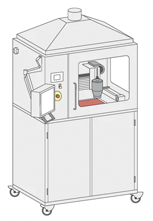
PlasmaSpot MINI
Compact laboratory device for research and development. Designed for feasibility testing and validation of new cold plasma applications on material samples.
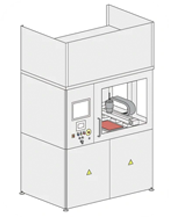
PlasmaSpot
Device for spot treatment and small surfaces. Designed for larger components and pilot production.
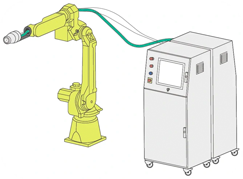
PlasmaSpot FLEX
Robotised workstation for treating components with complex geometries. Integration with robotic arms on automated production lines.
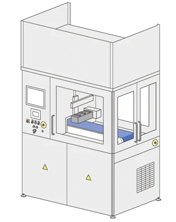
PlasmaLine
Industrial line for continuous treatment of flat and fibrous surfaces. Integration with existing production lines, high throughput.
Industries using cold plasma
Cold plasma technology finds application wherever surface properties determine product quality.
Automotive
Metal-to-polymer and metal-to-composite bonding, improved adhesion of paints and protective coatings.
Aerospace and defence
Composite functionalisation, anti-corrosion coatings, surface preparation for structural bonding.
Electronics
Protective coatings on PCBs, improved wettability before soldering, component encapsulation.
Medical
Antibacterial coatings on implants and instruments, biomolecule immobilisation on diagnostic surfaces.
Composites
Improved fibre-to-matrix adhesion, functionalisation of powders and carbon fibres prior to forming.
Book a demonstration day
We shall demonstrate how cold plasma technology performs on your materials. A one-day workshop with application trials and results discussion.
Arrange a meeting